By establishing an undergraduate scholarship through a charitable lead annuity trust, Bing Han AB ’11, MBA ’20 and his parents are helping to ensure that cost doesn’t prevent talented students from pursuing a Harvard education.
Education has been a driving force for Bing Han AB ’11, MBA ’20 and his family—and financial aid the means to pursue it.
A scholarship enabled Bing’s father, John, to emigrate from China in the 1990s to attain his PhD while supporting their family of three. When it came time for Bing to apply to college in 2007, financial aid once again played a critical role.
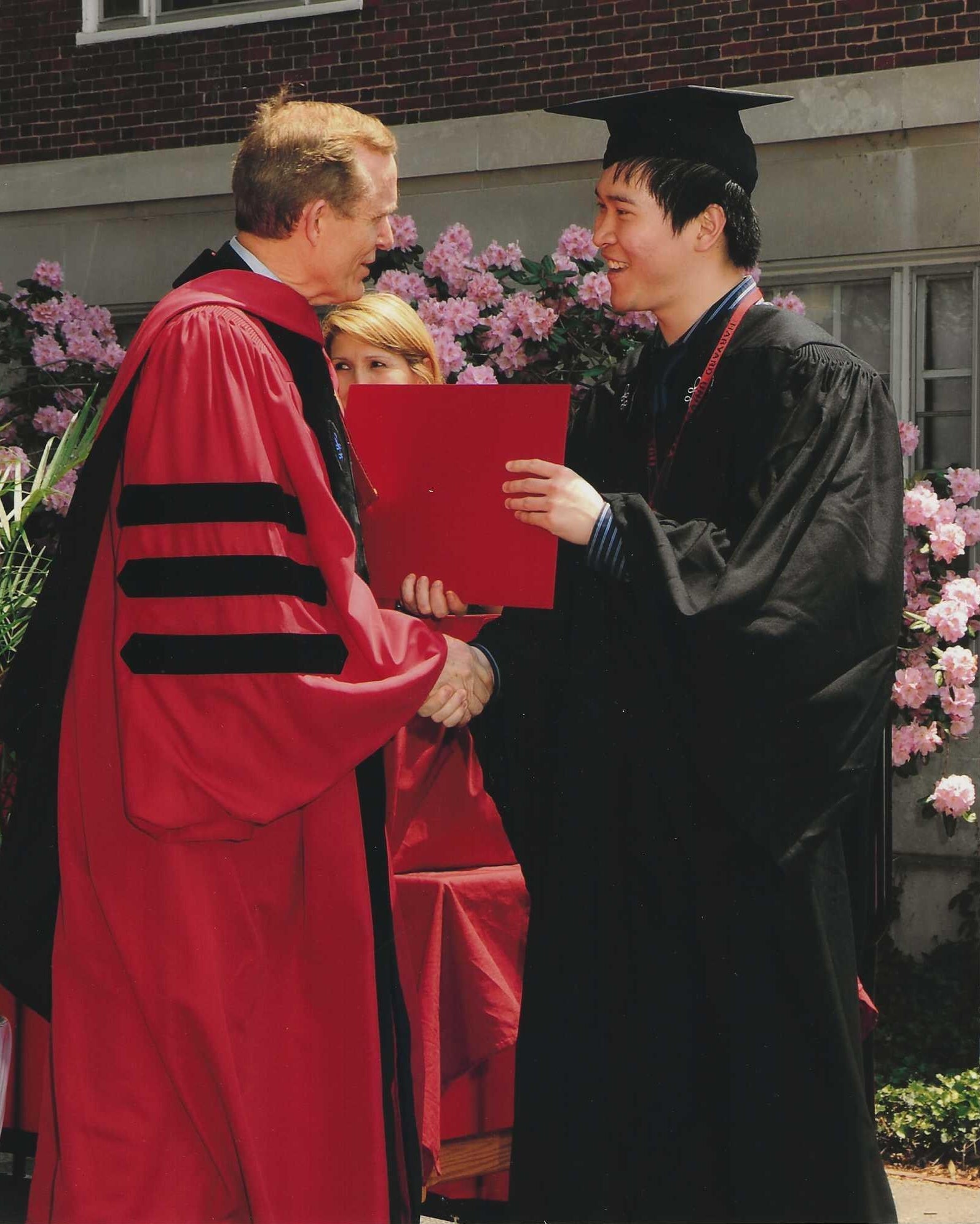
“We were a middle-class family, so financial support was one of the top deciding factors, and Harvard gave us a very generous package,” he explains. “If we were asked to pay the full cost at that time, it would not have been possible. I was grateful that I was given the opportunity not only to attend Harvard but also to afford it.”
During the summer of his sophomore year, Harvard provided support for another educational opportunity, helping to cover Bing’s travel and living expenses during an internship at a financial institution in Germany during the height of the Great Recession.
“My financial aid–related experiences really shaped my view of the University’s generosity and the impact it can have on a student,” Bing says. “Harvard’s given a lot to me when I needed it the most, so enabling other students to have the same opportunities is our family’s main motivation. If you get into your dream school, cost shouldn’t be a deterrent.”
With this in mind, Bing, his father, and his mother, Sharon, established the Han Family Undergraduate Scholarship Fund through a charitable lead annuity trust (CLAT).
A lesser-known planned giving vehicle, the Han Family CLAT provides Harvard with a fixed amount of money annually for a set number of years (both determined by the donor), activates the scholarship immediately, and provides Bing and his family with tax benefits. The trust is invested by Harvard without fees, and at the conclusion of the trust term the ending principal—including any investment gain—is distributed to the family’s designated beneficiaries. For some donors, CLATs are a desirable and tax-efficient way to pass inheritance along to heirs.
“I didn’t know this structure existed, and I’m thankful to the Harvard planned giving team for showing me many options before we decided on the CLAT structure. It was a pleasure working with the entire giving team,” he says.
He was also eager to support Harvard during a challenging time for the University. “I wanted to step up beyond the annual recurring gift that I was making,” explains Bing, who has been a longtime supporter of the Harvard College Fund. “While Harvard has a large endowment, so much of it is restricted. I wanted to help in whatever capacity I could.”
As a recipient of financial aid, Bing valued having the opportunity to engage with donors when he was an undergraduate, and he looks forward to doing the same for students who receive support from the Han Family Fund. “It was valuable for me because I got a chance to meet the alum who was supporting my education,” he says. “I could actually see the person who was making a difference in my experience.”
The gift coincides with Bing’s 15th Harvard College Reunion, which he is cochairing. He plans to attend not only with his wife and three young children but also with his parents.
“They have a strong connection and appreciation for Harvard and for what it’s done for me—and what it’s done for our family,” he says. “We’re truly blessed to have the opportunity to give back to the place that gave me so much.”