Travel through the Caucasus and Central Asia to explore how empire, religion, and everyday life have shaped Armenia, Georgia, and Uzbekistan. This program emphasizes historical depth, contemporary realities, and thoughtful engagement with local communities. Begin in Yerevan and the Ararat Valley, visiting early Christian monasteries and cultural institutions, and meeting with artists and musicians who are sustaining and reinterpreting regional traditions. In Georgia, continue to Tbilisi’s historic neighborhoods for architect-led walks, conversations with local scholars and community leaders, and opportunities to learn about the experiences of people who have been displaced by conflict, as well as the work of diplomats and civil society organizations in the region. Explore the wine-producing region of Kakheti, where vineyard visits and time in hill towns highlight the deep connections between landscape, agriculture, and culture. Fly east to Uzbekistan to explore its Silk Road cities—Tashkent, Khiva, Bukhara, and Samarkand. Visits to select sites provide context on the region’s layered histories, including trade, religion, and architecture under different empires. An optional extension to Azerbaijan offers further perspectives on the Caucasus through its own historical narratives, cultural institutions, and diplomatic landscape. Throughout the journey, the program aims to foster informed, respectful engagement with both the past and the present of this complex region.
Schedule by Day
Click each drop-down below to view a detailed itinerary. For a full view, please select the "print page" button above.
Depart on an overnight flight to Yerevan, Armenia
Upon arrival in Yerevan, meet your guide and transfer to the hotel to rest.
Overnight: Alexander Hotel
After breakfast, the day begins with a lecture led by your Harvard Study Leader, providing historical and cultural context for Armenia and its capital.Set out with a local guide for a walking exploration of Yerevan, taking in key sites such as Republic Square, lively Abovyan Street, the Cascade Complex with its public art and city views, the chic pedestrian Northern Avenue, and the exterior of the Opera and Ballet Theater. Midday includes a visit to the Megerian Carpet Museum to learn about Armenian carpet-making traditions, enjoy lunch paired with an Armenian wine tasting, and watch a presentation on Armenian national dress (Taraz). Later, visit the studio of a master craftsman to discover traditional Armenian reed instruments like the duduk, with time to relax over tea or coffee and cake. The full day concludes with a welcome dinner at a local restaurant featuring classic Armenian dishes.
Overnight: Alexander Hotel
Meals: B, L, D
This morning, depart Yerevan with a local guide to visit Khor Virap, a small monastery perched above the Ararat Valley with striking views of snow-covered Mount Ararat and a powerful connection to Gregory the Illuminator and Armenia’s early Christian history. Continue to the Temple of Garni, dramatically situated on a cliff above the Azat River Valley, to explore this restored first-century temple built during the reign of King Trdat I as part of a royal fortress. Nearby, visit UNESCO-listed Geghard Monastery, partially carved into the rock face, where cave chapels, rock-hewn tombs, and still-functioning churches create a hauntingly beautiful atmosphere. Enjoy a private a cappella concert of sacred music. Stop to observe a traditional lavash bread-baking demonstration, watching bakers roll, stretch, and bake the thin flatbread in a tonir oven before sampling it fresh and warm. In the evening, return to the hotel for a wine tasting and an engaging meeting with a local expert such as a journalist or politician.
Overnight: Alexander Hotel
Meals: B, L
Depart Yerevan and begin the journey toward Tbilisi, stopping first at the Alphabet Monument, a quiet hillside installation where the 39 letters of the Armenian script stand as sculpted forms honoring Mesrop Mashtots and his 5th‑century creation. Continue to UNESCO-listed Haghpat Monastery, set on a lush plateau above the Debed River Gorge, to explore its 10th‑century churches and courtyards, where Armenian medieval architecture is expressed through stonework, carvings, and surviving frescoes. Enjoy lunch at a local restaurant en route, sampling regional favorites before crossing into Georgia and settling into Tbilisi. In the evening, experience a traditional Georgian table, or supra, where a tamada (toastmaster) leads heartfelt toasts and stories over a lavish spread of dishes such as khachapuri, khinkali, and walnut-based specialties, all accompanied by the powerful sounds of Georgian polyphonic singing, one of Europe’s most ancient and distinctive vocal traditions.
Overnight: Marriott Tbilisi
Meals: B, L, D
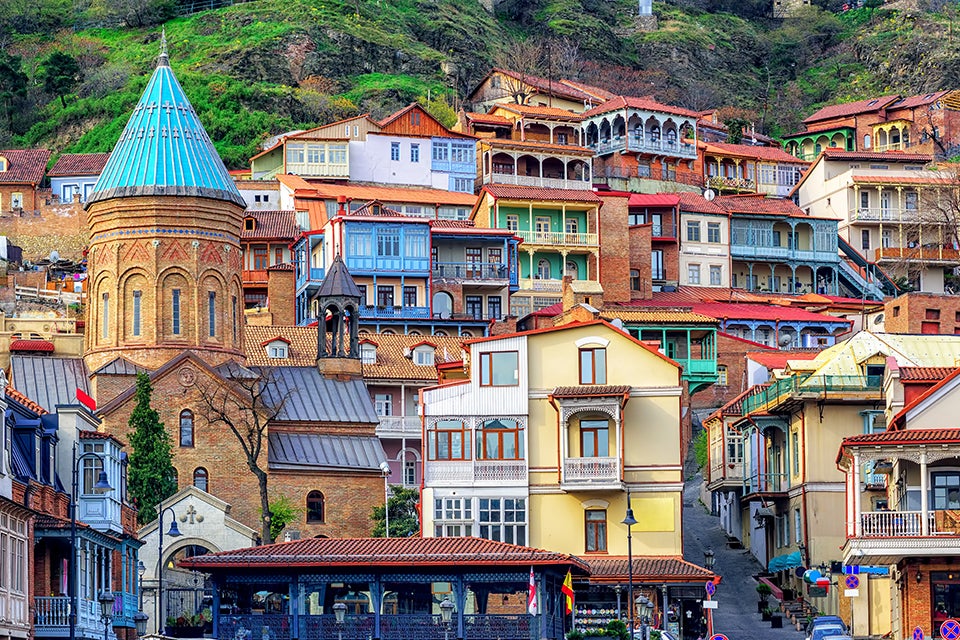
After breakfast, set out with a local guide to explore Tbilisi’s atmospheric Old Town, walking past the whimsical, storybook-like Gabriadze Leaning Tower to visit the 6th-century Anchiskhati Basilica, then continue into the Maidan and Abanotubani district to see the domed sulfur baths that have long defined the city’s thermal heritage. Later, join an architect-led tour of the Sololaki district, where restored Art Nouveau facades, ornate balconies, and grand staircases reveal the city’s turn-of-the-century elegance, pausing for an upscale Georgian lunch at Iasamani in the heart of the neighborhood. In the afternoon, experience Georgia’s dynamic wine culture with a natural wine tasting at The Warehouse in the Stamba Hotel, sampling minimal-intervention wines in a striking contemporary setting. Conclude the day at the Georgian National Museum's main Tbilisi site, where exhibits range from ancient gold treasures and 1.8-million-year-old hominid skulls to the powerful Soviet Occupation Hall, before enjoying an independent dinner, taking advantage of Tbilisi’s flourishing culinary scene.
Overnight: Marriott Tbilisi
Meals: B, L
After breakfast, the day begins with a roughly 2.5‑hour drive out of Tbilisi and a guest lecture by a local expert en route. Stop first in Tserovani IDP Village to meet residents displaced by the 2008 war and learn how they have rebuilt their lives through small businesses and community initiatives, such as the Ikorta artisan studio, where women artisans introduce the techniques of cloisonné enamel (minankari) jewelry. Continue into the countryside to the rustic retreat of former Georgian politician, for an informal meeting and conversation amid gardens, horses, homemade spirits, and a relaxed Georgian meal. Later, travel on to Mtskheta, the ancient capital and UNESCO World Heritage Site at the confluence of the Kura and Aragvi rivers, to explore its historic streets and deep Christian heritage, including a visit to the 11th-century Svetitskhoveli Cathedral, renowned for its monumental architecture, surviving frescoes and veneration as the burial place of Christ’s mantle. In the late afternoon, make the return drive to Tbilisi for dinner at a local restaurant.
Overnight: Marriott Tbilisi
Meals: B, L, D
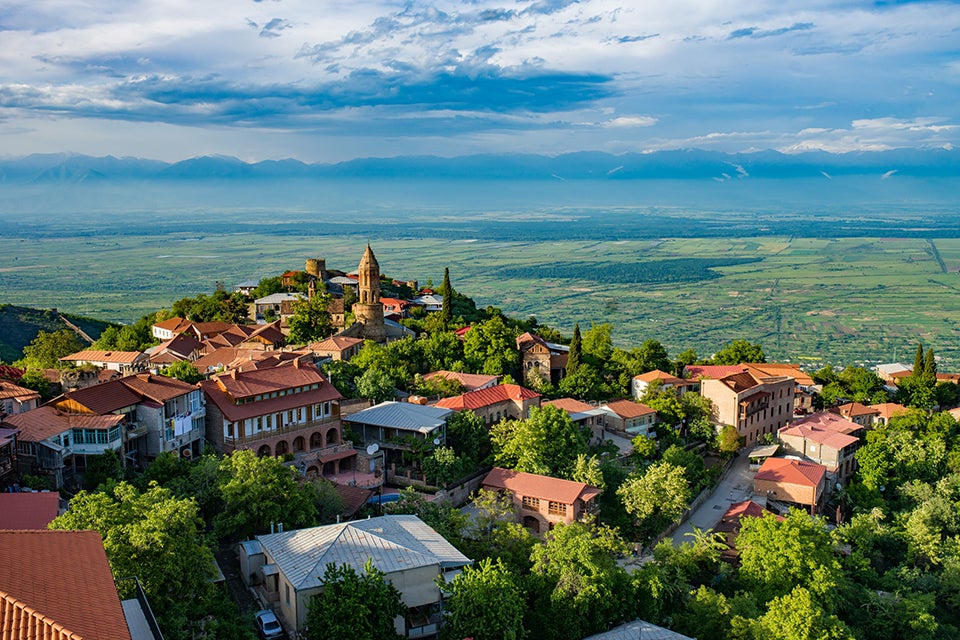
After breakfast, depart Tbilisi for the Kakheti wine region on a scenic drive of around 2.5 hours, heading toward the hilltop town of Signagi. Pause at Pheasant's Tears Tibaani Vineyards, to walk among the vines and step into the cellar, where grapes are fermented and aged in traditional clay qvevri buried underground—a method used in Georgia for some 8,000 years. Enjoy a leisurely wine tasting and lunch at the Crazy Pomegranate restaurant, savoring regional dishes and natural wines as you learn about Georgian viticulture, and, schedule permitting, meet co‑founder John Wurdeman for stories of his journey from American painter to leading winemaker and restaurateur. Continue to Signagi for a walking tour through its cobbled streets and alleys, then visit nearby Bodbe Nunnery, a working convent associated with St. Nino that overlooks the Alazani Valley. In the late afternoon, take a short drive to Qedeli Village and the Lost Ridge eco-village, where rolling green hills and distant churches frame a visit to the Fire Kitchen for a hands-on look at traditional Georgian bread baking and a demonstration of how churchkhela, Georgia’s signature grape-and-nut sweet, is made. The day concludes with dinner at Lost Ridge, featuring Kakhetian specialties paired with locally brewed beers.
Overnight: Kabadoni Hotel
Meals: B, L, D
After breakfast, check out of the hotel and transfer directly to Tbilisi Airport for your late-morning flight to Tashkent, Uzbekistan. Upon arrival, transfer into the city to settle into your hotel and begin to get a feel for Tashkent’s blend of Soviet-era boulevards, Islamic architecture, and emerging modern skyline. In the evening, gather for dinner at a local restaurant, enjoying traditional Uzbek dishes as an introduction to the country’s rich culinary and cultural heritage.
Overnight: Swissôtel Tashkent
Meals: B, D
After breakfast and check-out, meet your guide to begin exploring Tashkent, discovering how this ancient Silk Road city blends reconstructed Old Town alleys with wide Soviet boulevards and modern landmarks. Visit the new Center for Islamic Civilization for an introduction to Central Asia's role in Islamic scholarship and home to the revered 7th-century Uthman Koran, one of the world's oldest surviving Qurans. Continue underground to ride the Tashkent Metro, admiring its chandelier-lit, marble-clad stations, and pause outside the Alisher Navoi Theatre, a grand 1940s opera house named for Uzbekistan’s most beloved poet. Pass by Independence Square, with its monuments to sovereignty and wartime sacrifice, and the Courage Monument, commemorating the massive 1966 earthquake and the city’s remarkable rebuilding. Transfer to the airport for the flight to Urgench, then continue by road to nearby Khiva.
Overnight: Farovon Khiva Hotel
Meals: B, L, D
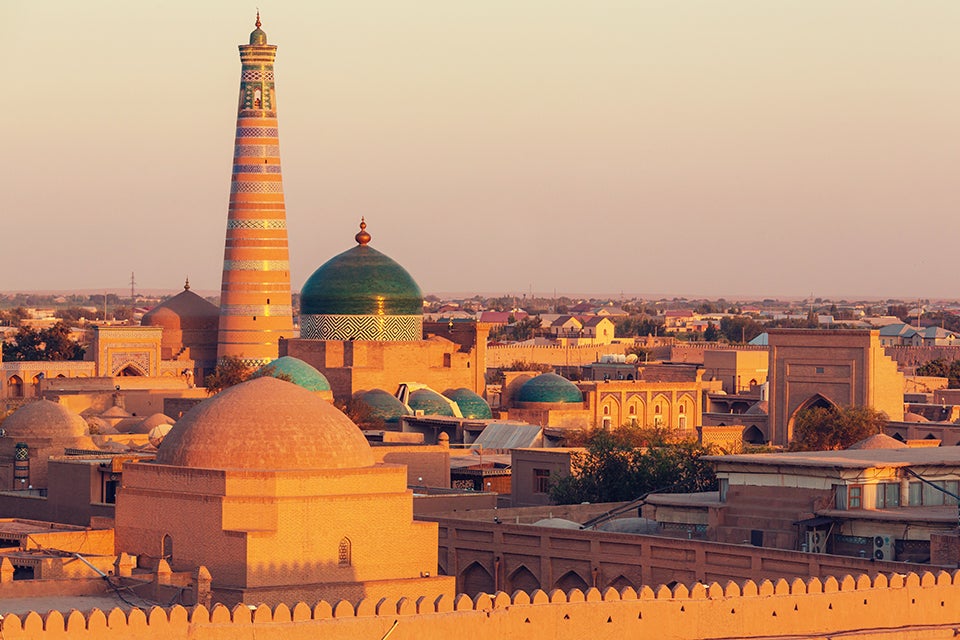
After breakfast, enjoy a lecture led by your Harvard Study Leader, before you set out on a walking exploration of the walled Ichon Qala, a UNESCO-listed inner city that still evokes the atmosphere of the Silk Road. Wander through its mud-brick streets to visit the Islam Khoja Madrassah and its soaring minaret, the tallest in Uzbekistan, then step into the shadowed interior of the Juma Mosque, where 115 carved wooden columns create a forest-like effect. Here, meet a local expert for an interpretation of the woodcarvings, and a Qaree who chants verses from the Koran, explains their meaning. Continue to the Kalta Minor, the striking unfinished “short minaret” clad in shimmering bands of turquoise tile, and explore the Kunya Ark, the khan’s former fortress and residence with its tile-lined courtyards and historic throne room. Visit a traditional woodcarving studio inside the city walls to meet master craftsmen and see how centuries-old techniques transform elm and walnut into ornate doors, pillars, and decorative panels. Later, admire the emerald dome of the Pahlavan Mahmud Mausoleum, dedicated to Khiva’s poet-wrestler patron saint, and tour the expansive Tash-Hauli Palace, where lavish blue-and-white tilework, carved columns, and ganche plasterwork adorn the khan’s former reception halls and harem. The full day concludes with dinner at a local restaurant, savoring regional Uzbek specialties.
Overnight: Farovon Khiva Hotel
Meals: B, L, D
After breakfast, check out of the hotel and meet your guide to begin the overland journey from Khiva to Bukhara, traveling roughly 6.5 hours across the vast Kyzyl Kum, or “Red Sand,” Desert. Settle into your hotel, then head out for dinner at a local restaurant, sampling traditional Uzbek dishes as an introduction to Bukhara’s storied Silk Road heritage.
Overnight: Wyndham Bukhara
Meals: B, L, D
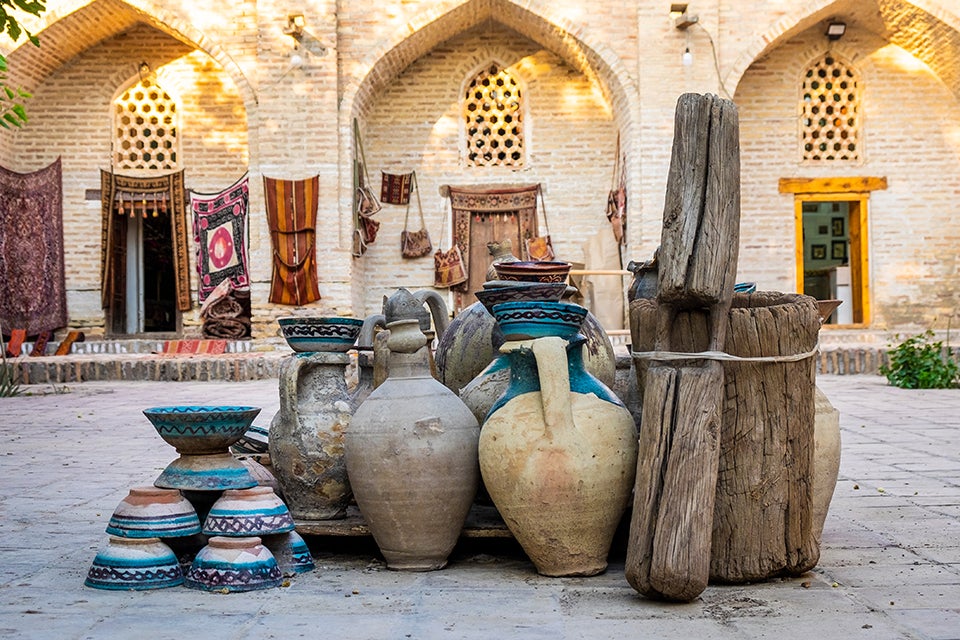
After breakfast and a lecture by your Harvard Study Leader, set out on a walking tour of the Old Town, where you step into the Ark Citadel for an archaeologist-led visit that reveals layers of history behind the former emir’s fortress, then continue to the nearby Zindan Prison to see the infamous “bug pit” tied to the 19th-century Great Game. Pause in a leafy park at the beautifully patterned Samanid Mausoleum, a 10th-century masterpiece of brickwork, and visit the Chashma Ayub complex (Job’s Well), associated with the prophet’s miraculous spring. Enjoy a hands-on plov-making demonstration over lunch at a family-run venue, learning how Uzbekistan’s signature rice dish comes together before tasting the results. Later, admire the four blue-topped towers of the Chor Minor madrassah and attend an intimate performance with shashmaqom masters, whose traditional music and Sufi-influenced poetry have deep roots in Bukhara’s multiethnic heritage. As the day draws to a close, ascend the restored Shukhov Water Tower for drinks and panoramic views, taking in the domes and minarets of old and new Bukhara spread out below.
Overnight: Wyndham Bukhara
Meals: B, L, D
After breakfast, drive about 45 minutes outside Bukhara to the village of Shafirkan for a visit to a family-run suzani cooperative, where the entire process of creating these richly embroidered textiles—from silk cocoons and natural dyeing to drawing intricate patterns and stitching flowers, pomegranates, and swirling vines by hand—can be seen. Visit the Emir’s Summer Palace, the “Palace of Moon and Stars,” built for the last emir at the turn of the 20th century. Stroll through tree-shaded grounds where peacocks wander among pavilions and arbored walkways, then step inside the lavishly decorated residence and its smaller outbuildings to reflect on how this luxurious yet somewhat isolated retreat symbolized the emir’s diminished power under Russian control. Enjoy an evening at your leisure.
Overnight: Wyndham Bukhara
Meals: B, L
After breakfast, enjoy a leisurely morning in Bukhara, with time to rest at the hotel or set out independently to wander the Old Town’s lanes, revisit favorite sites, or shop for last-minute crafts. Alternatively, join an optional guided visit to the historic Jewish Quarter, once home to thousands of Bukharan Jewish families who developed their own distinct dialect, customs, and religious practice over centuries of relative isolation. Step inside the modest main synagogue near Lyabi-Hauz to meet with a representative of the Bukharan Jewish Community, view a treasured Torah scroll safeguarded here for generations, and listen to a traditional Haqqani, an a cappella religious song in Tajki Persian that embodies the community's deep spiritual heritage. In the afternoon or early evening, board the train from Bukhara to Samarkand, watching the desert landscape roll by before arriving in one of the Silk Road’s most storied cities. Settle into your hotel, then gather for dinner at a local restaurant, enjoying Uzbek favorites as an introduction to Samarkand’s rich cultural tapestry.
Overnight: Movenpick Hotel
Meals: B, D
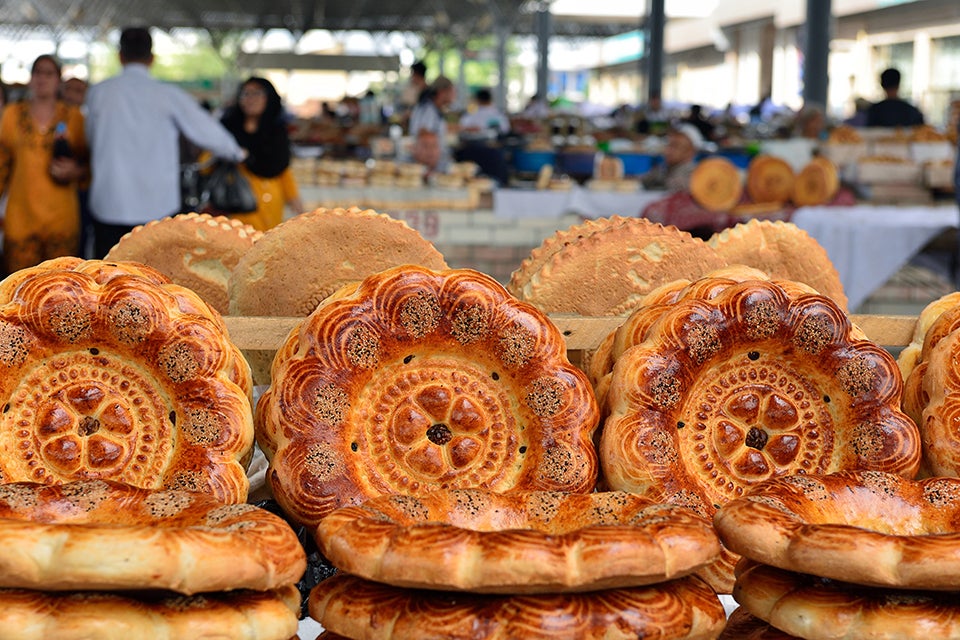
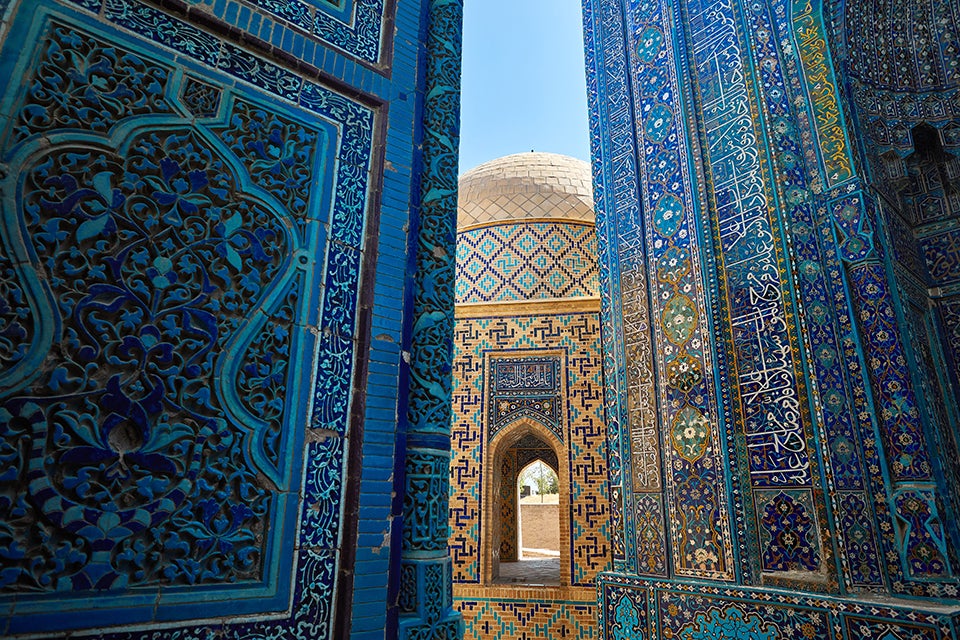
This morning, walk into Registan Square to take in the three soaring madrassahs that frame the city’s most iconic plaza, then leave the main roads behind for a stroll through one of Samarkand’s oldest neighborhoods, wandering narrow lanes from the Registan to the vast Bibi Khanum Mosque. Visit Bibi Khanum to admire its monumental blue-tiled dome and restored marble courtyards, then cross to the lively Siab Bazaar, where stalls overflow with fresh produce, nuts, spices, and local breads. Continue to the Shah‑i‑Zinda necropolis, a striking avenue of turquoise‑domed mausoleums that leads from the living city into the ancient burial grounds of Afrosiab, before pausing for a traditional bread‑baking demonstration to see how tandir‑baked non is shaped, stamped, and fired. Cap the day with drinks and hors d’oeuvres, taking in sweeping views over Registan Square, and then watch the Registan night sound‑and‑light show, as music and projections animate the intricate facades.
Overnight: Movenpick Hotel
Meals: B, L, D
After breakfast, check out of the hotel and meet your guide to delve deeper into Samarkand’s layered history, beginning at the Afrosiab History Museum, where an archaeologist leads a private tour of artifacts and murals unearthed from the ancient, pre‑Tamerlane city that once stood on the nearby hills. Delve into Silk Road craft with visits to local artisans that may include a musical instrument maker near Registan Square, where traditional instruments such as the doira and gijak are built and played by hand, and a block-printing workshop where designs are carved into wooden blocks and stamped with natural dyes onto cotton, reviving a textile art with roots going back to the 11th century. After lunch at a local restaurant, enjoy a free afternoon for independent exploration—perhaps revisiting favorite monuments, browsing handicraft shops, or simply relaxing. Later in the day, transfer to the railway station to board the train from Samarkand to Tashkent, then gather in the evening for a farewell dinner, reflecting on the journey over a final meal of traditional Uzbek dishes.
Overnight: Swissôtel Tashkent
Meals: B, L, D
After breakfast at the hotel, check out and transfer by private vehicle to Tashkent Airport. Bid farewell to Central Asia as you board your onward flight, carrying home memories of Silk Road cities, desert landscapes, and the people and traditions encountered along the way.
Meals: B
Pricing
Double Occupancy
Single Occupancy
$11,595 per person
$13,340
On-tour flights Tbilisi/Tashkent, Tashkent/Urgench: Approximately $435 (taxes included) per person (subject to change until ticketed)
• All accommodation based on double occupancy per itinerary with breakfast daily, local service charge and tax (standard hotel check-in/out times apply unless otherwise noted) • Private vehicle for one group arrival and one group departure transfer per itinerary at airports and railway stations • Transportation per itinerary by private vehicle • All sightseeing and excursions including entrance fees per itinerary • Local English-speaking guides throughout itinerary • Special cultural features as stated in itinerary • Services of a MIR tour manager throughout the land program • Special Welcome and Farewell Dinner • Meals as listed in itinerary, breakfast daily, 13 lunches, and 12 dinners • Bottled/purified water, and local beer or wine with all lunches and dinners • Gratuities to tour manager, local guides, drivers • Baggage handling at the hotel • Destination preparation information packet
• Internal Air tickets for the flights from Tbilisi to Tashkent one-way, and from Tashkent to Urgench one-way, with taxes included. (Currently $435 per person, subject to change until ticketed) • International airfare to/from the start and ending cities; air taxes or fuel surcharges; increases in local taxes/VAT; pre- or post-tour services; visa or passport fees; medical and trip interruption insurance; evacuation costs; food or beverages not included in group meals; items of a personal nature such as laundry, alcohol, telephone expense, excess baggage fees, photo/video expenses inside museums (where allowed); other items not expressly listed as included.
To reserve a space on this program, a $2,000 deposit is required per person. Final payment is due 120 days before departure (December 20, 2026) payable by check or bank transfer. Participants will receive an invoice directly from the tour operator, MIR Corp. for all subsequent payments after the initial deposit.
Notification of cancellation must be received in writing by HAA from the participant. Cancellations received within 14 days of booking are eligible for a full refund, provided that initial deposits were made 121 days or more prior to departure. After 14 days, $1,000 per person becomes non-refundable.
The program terms and conditions can be found here and must be acknowledged upon registration.
Accommodations
Yerevan (3 nights) at Alexander Hotel
Tbilisi (3 nights) at Marriott Tbilisi Hotel
Signagi (1 night) at Kabadoni Hotel
Tashkent (2 nights in two stays) at Swissotel Hotel
Khiva (2 nights) at Farovon Khiva Hotel
Bukhara (3 nights) Wyndham Bukhara Hotel
Samarkand (2 nights) at Movenpick Hotel
Optional Post-Tour Extension: Azerbaijan
May 6 - 9, 2027
Extend your journey with three days in Baku, Azerbaijan, discovering a Caspian Sea capital where ancient fire-worship, Silk Road trade, and modern oil wealth converge. Begin with a flight from Tashkent, settling into your hotel before exploring Baku’s UNESCO-listed Old Town, imposing Shirvan Shah Palace, enigmatic Maiden Tower, and lively Fountain Square. Delve into Azerbaijan’s history and culture at Martyrs’ Lane, the Villa Petrolea Nobel Brothers Museum, and the Culinary Arts Center of Azerbaijan, where a hands-on class introduces classic dishes like Shah Plov and gutabs. Venture beyond the city to Gobustan’s remarkable petroglyphs and the Ateshgah Fire Temple, then admire Zaha Hadid’s spectacular Heydar Aliyev Cultural Center before a farewell dinner at Mugham Club, featuring traditional Azeri cuisine, mugham music, and national folk dance.
Overnight: Baku Four Seasons Hotel (3 nights)
Meals: 3B, 2L, 1D
$2,195 per person, double occupancy
$3,190 single occupancy
The opportunity to register for the extension will be provided directly from the tour operator following the participants confirmation on the program
What to Expect
Activity Level 3
This trip is active due to the substantial distances covered and the extensive walking and stair climbing required. The tour is not wheelchair accessible. To reap the full rewards of this adventure, travelers must be able to walk at least two miles a day (with or without the assistance of a cane) over uneven terrain while keeping up with the group; and stand for extended periods of time during walking tours and museum visits. Availability of western toilets on the trip is unreliable when outside of major cities. Accommodations on this program are at five-star properties in the capitals, and four-star hotels in smaller cities. Flexibility and willingness to accept local standards of service and amenities are essential to the enjoyment of this program.


 This trip is active due to the substantial distances covered and the extensive walking and stair climbing required. The tour is not wheelchair accessible. To reap the full rewards of this adventure, travelers must be able to walk at least two miles a day (with or without the assistance of a cane) over uneven terrain while keeping up with the group; and stand for extended periods of time during walking tours and museum visits. Availability of western toilets on the trip is unreliable when outside of major cities. Accommodations on this program are at five-star properties in the capitals, and four-star hotels in smaller cities. Flexibility and willingness to accept local standards of service and amenities are essential to the enjoyment of this program.