Date
Mar 14, 2027 - Mar 27, 2027

Group Size: 12 - 23 participants
Price: Starting from $7,695 per person, double occupancy 
Co-sponsored with: Harvard Exclusive

Activity Level
3

Trip Overview

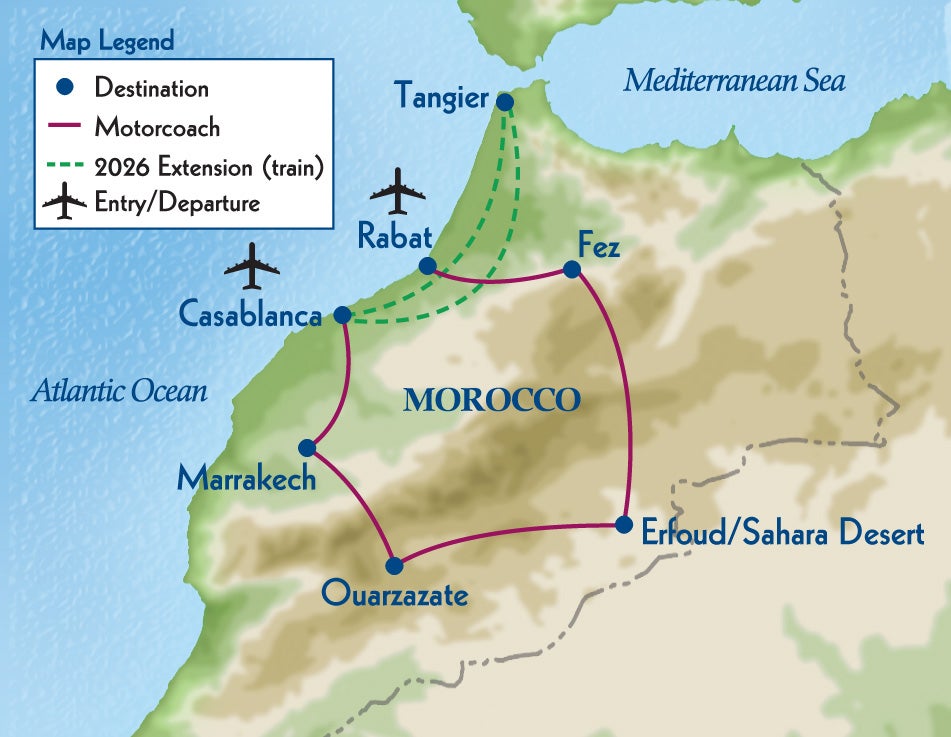
Travel from Morocco’s Atlantic coast to the edge of the Sahara on this 14-day journey that reveals the country’s imperial cities, ancient medinas, and dramatic landscapes. Begin in the capital, Rabat, exploring royal palaces, Roman ruins, seaside kasbahs, and the atmospheric medina before traveling via wine country, historic Meknes, and the Roman archaeological site of Volubilis en route to Fez, the country’s spiritual and intellectual heart. Spend time inside Fez’s extraordinary, car-free medina, visiting centuries-old madrasas, craft quarters, markets, and the Jewish quarter, then cross cedar forests and mountain passes to the desert outpost of Erfoud, gateway to the Sahara. Ride 4x4s and camels to the towering dunes of Merzouga for a sunset desert experience, then follow the Route of a Thousand Kasbahs past palm-filled oases, rose-growing villages, and dramatic gorges to Ouarzazate and the iconic ksar of Ait Ben-Haddou. Continue over the High Atlas to Marrakech, where you discover opulent palaces, historic madrasas, world-famous gardens, vibrant souks, and the legendary Djemaa El Fna square, before concluding in cosmopolitan Casablanca with a visit to the monumental Hassan II Mosque and a festive farewell celebrating the flavors, artistry, and hospitality of Morocco.

itinerary map

calendar icon

Schedule by Day

Click each drop-down below to view a detailed itinerary. For a full view, please select the "print page" button above.

We depart the U.S. for Morocco today with a connecting flight to Rabat.

We arrive today in Rabat, Morocco’s capital city known for its history, architecture, and culture (note: the hotel’s check-in time is 3:00 p.m.). There, we have a short time to rest and refresh ourselves before meeting our fellow travelers at a welcome briefing. We then enjoy a welcome dinner together at Dinarjat, an acclaimed restaurant in Rabat’s Old Town serving traditional Moroccan fare.

Overnight: La Tour Hassan Palace

Meals: D

Capital of the French Protectorate of Morocco from 1912 to 1956 and capital of Morrocco since its independence, Rabat resembles several celebrated European cities yet maintains an Islamic character all its own. We spend the entire day touring this unique locale, which also served as one of the four ancient capitals, or imperial cities. We start inside the vast square of Dar al-Makhzen, the primary home of Mohamed VI, king of Morocco. We then visit the Roman site of Chellah, where we see the remnants of Sala Colonia, a port that was abandoned in 1154. The gardens, pavilions, and ruins here are spread out over multiple levels, and now house a number of curious cats and majestic storks. 

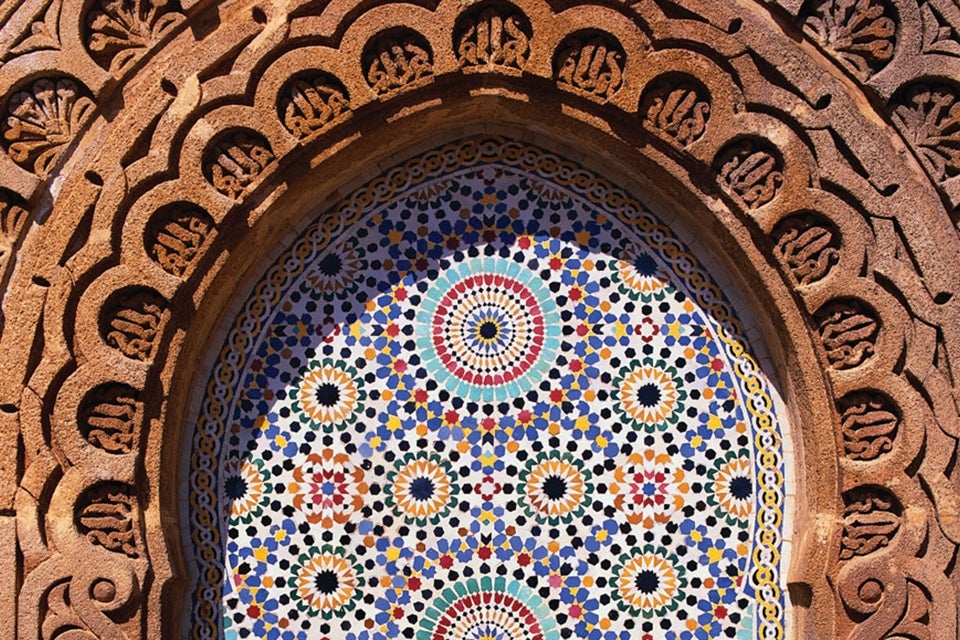
Continuing our tour of the city, we visit the Bank Al Maghreb Museum before crossing the river to Sale, where we enjoy lunch in a private home. After our meal, we admire the stunning architecture of the Mausoleum of Mohamed V, built for the grandfather of the current king. The tilework and attention to detail in the building are extremely impressive, as is the setting: it stands across a wide plaza from the 12th-century Hassan Tower. From here, we visit the fortified Kasbah of the Oudaias, which calls to mind Santorini with signature blue and white buildings lining narrow streets, beautiful Andalusian Gardens, and a wide plaza overlooking the mouth of the Bou Regreg River. We finish our day with a short walk through the medina (the historic city center), a UNESCO site and the first of many medinas we encounter on this tour. Late this afternoon, we return to the hotel and enjoy dinner together there tonight.

Overnight: La Tour Hassan Palace

Meals: B, L, D

This morning, we depart by motorcoach for Fez, making a few stops along the way. First, we discover one of the finest wine estates in all of Morocco: Château Roslane. Covering over 3,000 acres – 1,500 of which are planted with vines – it is the first winery in North Africa to be classified as a “Château,” having earned the coveted “premier cru” distinction. The building housing the winery dates back to 1948 and its mammoth tanks can handle enough wine to fill 10 million bottles. After a comprehensive tour of the facility, it’s time for lunch and a wine tasting in the charming restaurant overlooking the vineyards.

After lunch, we drive by the city of Meknes, Morocco’s youngest Imperial City, designated as the nation’s capital during the reign of the Sultan Moulay Ismail in 1672. Despite his reputation as a ruthless warrior, the Sultan was also a builder, and during his 55-year reign he developed Meknes from a small town into a majestic city with gigantic ramparts, monumental gates, more than 50 palaces, and 15 miles of exterior walls. We pass this historic destination and continue on to Volubilis, the largest of the Romans’ 17 colonies established in Morocco between the 1st century BCE and the 2nd century CE. The excavated ruins here are particularly noted for their colorful mosaics, and the hilltop setting is a photographer’s delight; columns and archways frame lovely views across the Moroccan countryside. While learning the history from a local guide, we have ample time at this UNESCO World Heritage Site to explore and take photos. Then it’s on to Fez, where we arrive late this afternoon. Tonight, we enjoy a traditional Moroccan dinner together at our hotel perched on a hill overlooking the Fez medina.

Overnight: Riad Fes

Meals: B, L, D

Known as the “Athens of Africa” for its wealth of cultural, educational, and religious institutions, Fez is the country’s oldest imperial capital, and perhaps its most fascinating. “The history of Fez,” writes author Walter Harris, “is composed of wars and murders, triumphs of arts and sciences, and a good deal of imagination.” A more captivating city you won’t find anywhere, as we discover on our full-day tour. 

We begin today with a walk through some of the oldest and most authentic handcraft streets in the medina. Then we visit the Al-Attarine Madrasa, whose highlight is a small courtyard showcasing intricately detailed tilework and carving decorations dating to the early 1300s. We continue our discovery of the labyrinthine medina, focusing on the artisans’ quarters, the 14th-century Koranic schools, and Al Karaouine, the medieval theological university. This last spot is of particular interest, as the University of Al Karaouine was founded in 859 CE, giving it a host of superlatives: world’s oldest continually operating university, world’s first degree-awarding educational institution, and oldest school founded by a woman (Fatima al-Fihri). 

The medina is truly the highlight and heartbeat of this ancient city; its 540 acres contain some 156,000 residents, as well as thousands of twisting, narrow streets; food, spice, and plant markets; and shops selling almost anything imaginable. Donkeys and the occasional scooter break up the flow of pedestrians – with its streets too narrow and crowded for automobiles, the medina here is believed to be the largest car-free urban area in the world. We enjoy lunch at an interesting property hidden within the medina, then continue on to discover some hidden treasures, including the Dar Batha Museum of Islamic Arts, set in a 19th-century 

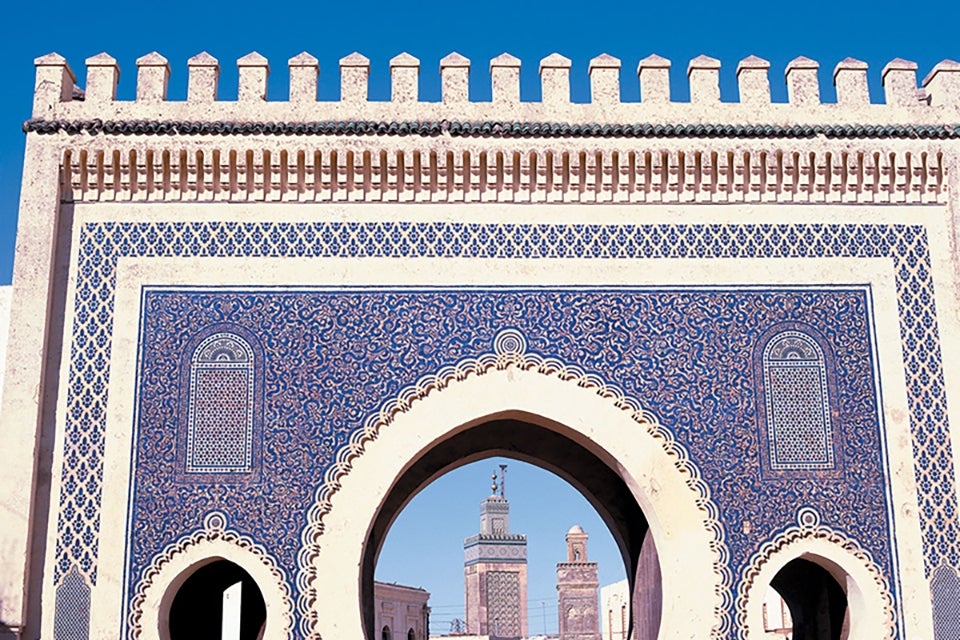
palace; the authentic food market; and the Blue Gate, the most picturesque of all the Old City’s historic gates. Tonight, we enjoy a private dinner at an intimate family-run riad in Fez.  

Overnight: Riad Fes

Meals: B, L, D

This morning, we start with a tour of the old Mellah (Jewish quarter) and its 17th-century synagogue, cemetery, and royal gates. Starting with the historic Jewish cemetery, a place of pilgrimage and meditation for many Jewish people from around the world whose ancestors lived in Fez. We then visit the 17th-century synagogue known as Aben Danan synagogue, and we will hear stories about the Jewish past of Morocco and what the “Tsadikims” accomplished during their lifetime. Continuing on, we visit the quarter where Fez’s renowned pottery and ceramics are made. Here, artisans create the complex blue-and-white geometric patterns of traditional “bleu de Fez” household and decorative objects. The remainder of the afternoon is free for lunch on our own and for independent exploration or relaxation. Your tour director will be happy to offer suggestions. We dine tonight in our hotel’s international restaurant.

Overnight: Riad Fes

Meals: B, D

Today’s transfer from Fez to Erfoud in the Sahara Desert is long, but our reward is the breadth and beauty of the passing scenery. Traveling inland, we cross the fertile plains beyond Fez and continue through the Middle Atlas mountain range and its cedar forests. Here, we may see the local Barbary apes in their natural habitat. We stop in the small town of Midelt for lunch before crossing the Ziz River, passing rows of sky-scraping palm trees and fortified villages and reaching our kasbah-style hotel on the outskirts of Erfoud late in the day. Built by the French as an oasis fort, Erfoud is now a sizable city and the gateway to the Sahara. Dinner tonight is at our hotel. 

Overnight: Le Palais du Désert Hotel & Spa

Meals: B, L, D

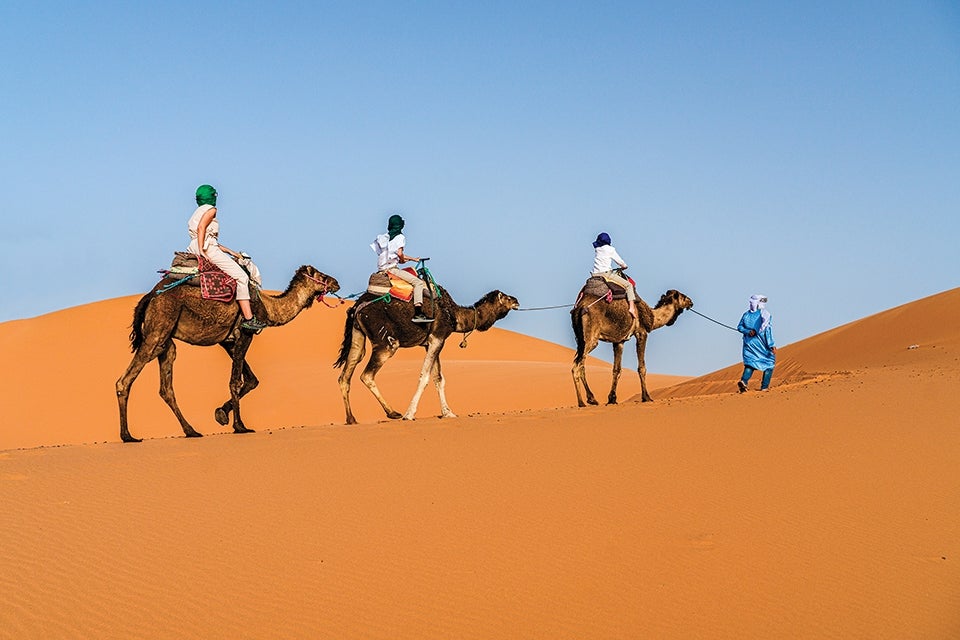
This morning, we visit the city of Rissani, sitting on the edge of the Sahara and formerly the last staging post on the southern caravan route. Traders would stop here before embarking on their journeys across the Sahara, either south to sub-Saharan Africa or east to the Levant. Once the seat of the Alawait dynasty, Rissani boasts striking architecture with its 18th-century ksar, a virtually impenetrable warren of alleys. After our touring here, we enjoy lunch together and then set out in a caravan of 4x4s for the breathtakingly beautiful dunes of Merzouga on the edge of the Sahara. After reaching Morocco’s only Saharan dunes late this afternoon, we meet and mount our camels, who carry us along the shifting sands of the erg (dune field) at the very edge of the world’s largest desert. We take a few moments amid the enormous silence to watch the sun sink behind the distant dunes. Following this experience, have dinner together in this desert setting before returning to our hotel tonight.

Overnight: Le Palais du Désert Hotel & Spa

Meals: B, L, D

With a long travel day ahead of us, we leave Erfoud this morning, bound for Ouarzazate in the snow-topped High Atlas Mountains. We pass one scene of natural beauty after another: first, Tinehir, a stunning mountain oasis rising on a series of lush riverside produce gardens accented by palm trees and dominated by ornate clay villages. Then, continuing our drive, we visit either Dades or Todra Gorge, two spectacular natural chasms with sheer rock faces rising from both sides of a narrow river. After enjoying lunch at a local restaurant, we continue on to El Kelaa des Mgouna, Morocco’s “rose capital,” before beginning our journey along the “Route of a Thousand Kasbahs,” a region of fortresses with elaborately decorated façades. We arrive in Ouarzazate (the “door of the desert”) late this afternoon; dinner tonight is at our hotel.

Overnight: Le Berbère Palace

Meals: B, L, D

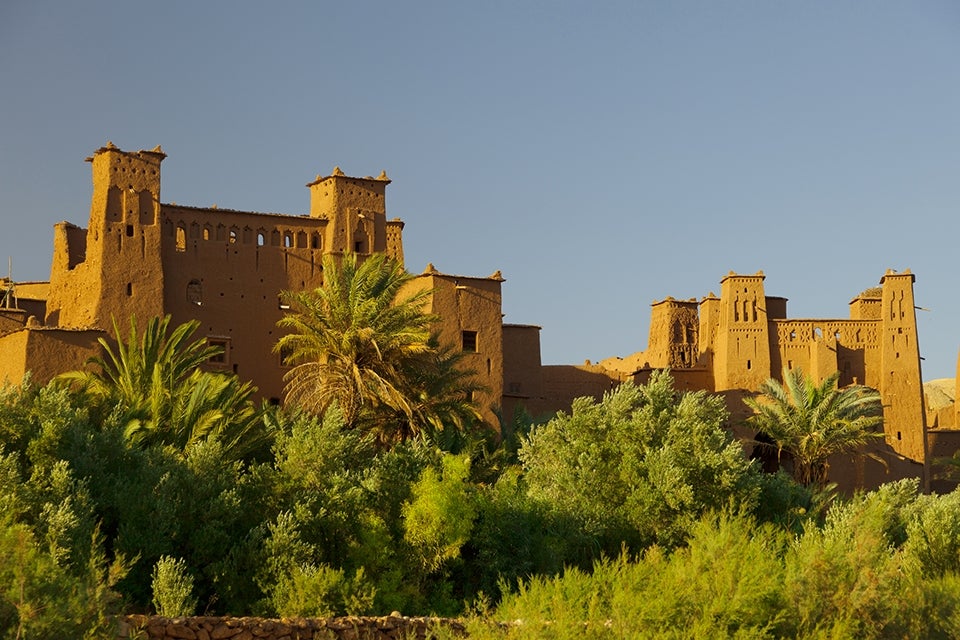
We leave Ouarzazate for Marrakech today, stopping en route at uninhabited Ait ben-Haddou, one of southern Morocco’s most recognizable villages since it is often used as a location for fashion shoots and films (including Ridley Scott’s Gladiator). A UNESCO World Heritage site, the village’s old section consists of deep red kasbahs so tightly packed together they appear as a single building. Because of the fragility of the buildings – along with the difficulty in negotiating rough terrain within the city proper – we limit our visit to a panoramic stop to view the city from a nearby hill. Then, as we descend from the High Atlas Mountains, we pass through typical villages with fortified walls and stone houses with earthen roofs. In Tizi N’Tichka, we traverse the Pass of the Pastures (alt. 7,415 feet), where life is much as it was centuries ago: shepherds bring their flocks to the high pastures every summer, then return with them to their villages in autumn. Late this afternoon we arrive in fabled Marrakech, an ancient intersection of Berber, African, Mediterranean, and Asian cultural and artistic influences. Considered Morocco’s most cosmopolitan city – and some would say its most beautiful – Marrakech boasts a spectacular location surrounded by rich farmlands and high mountains. We dine tonight at our hotel.

Overnight: Sofitel Marrakech

Meals: B, L, D

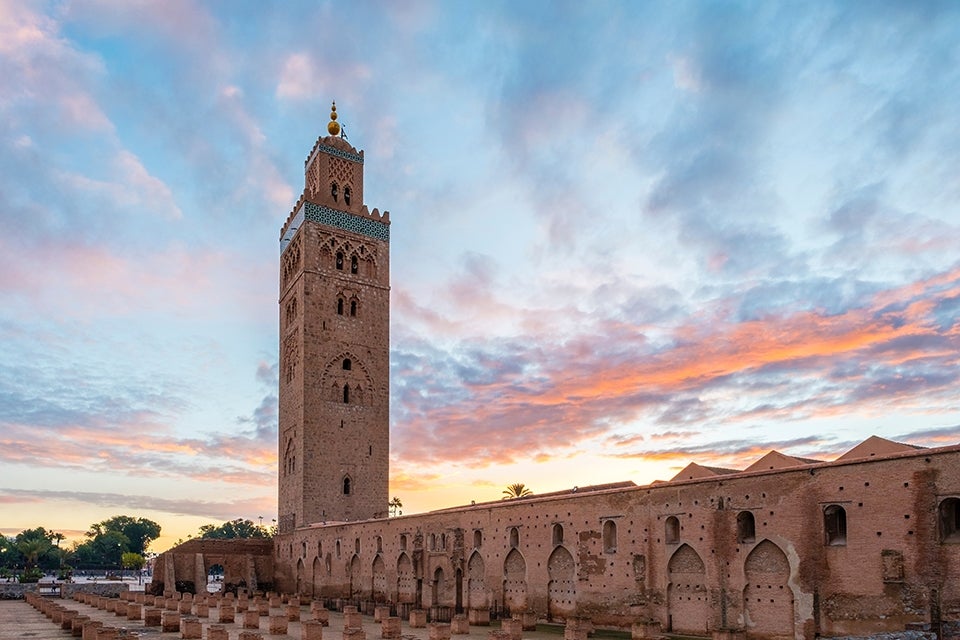
Although its origins are disputed, it is believed Marrakech was settled in the early 11th century; five centuries later it was one of Morocco’s dominant centers of art and culture. Today Marrakech is the nation’s fourth largest city, with an exciting blend of modern architecture and an ancient walled medina. We start by traveling via horse-drawn carriage along the city’s earth-made walls, stopping to visit the Koutoubia Mosque with its distinct 282-foot minaret, an architectural highlight visible from miles away; the relatively contemporary (20th-century) Dar el Bacha, onetime private residence of pasha (roughly “governor"); and the newly restored and recently reopened Ben Youssef Madrasa, built in 1565 by Saadian sultan Abdallah Al-Ghalib. This historic institution once reigned as the largest and most prestigious Islamic school in all of Morocco, attracting students from far and wide to deepen their knowledge in philosophy, mathematics, medicine, and religious sciences. Today, the madrasa stands as an architectural treasure reflecting the colorful history of authentic Moroccan art and culture. We return to our hotel for lunch before we setting out at mid-afternoon to explore the city’s souks, including those of yarn dyers, wrought iron and lantern makers, herbalists, wood carvers, and painters. Next, we venture to Djemaa El Fna, the heart of Marrakech where our fantasies of Morocco come to life. Here are snake charmers, storytellers, acrobats, and musicians asking only a few dirhams to enlighten, fascinate, and entertain. It’s an atmosphere that has existed since the city’s earliest days, serving as a mecca for both locals and tourists who come here for food, for fun, or to find a brief respite from daily life. Dinner is on our own tonight.

Overnight: Sofitel Marrakech

Meals: B, L

We start today with a stop to see the oldest historical gate of Marrakech, Bab Agnaou, built in the 12th century, before setting out to the lush Majorelle Gardens, a botanical garden in the heart of the city. French artist Jaques Majorelle created this masterpiece, known for its cobalt blue accents, in 1924 during Morocco’s colonial period as a protectorate of France. Here we are likely to see many of the 15 species of birds native to North Africa. Following a tour of the gardens, we visit the Yves St. Laurent Museum directly adjacent to Majorelle, where we have time to wander through and learn about the famed French designer and his deep connection to Morocco. The afternoon is at leisure before we enjoy dinner tonight at a local restaurant in the city’s Old Town.

Overnight: Sofitel Marrakech

Meals: B, D

We leave Marrakech this morning for the 3½-hour motorcoach ride to storied Casablanca, Morocco’s largest and most sophisticated city featuring French and Moroccan influences. On this afternoon’s tour, we visit the Grand Mosque of Hassan II, the world’s second largest Islamic house of worship, with a 656-foot minaret and a prayer hall three times the size of St. Paul’s Cathedral in London. A stunning architectural achievement, the mosque boasts an equally stunning setting on the banks of the Atlantic shoreline. It is also Morocco’s only functioning mosque that is open to non-Muslims and our tour affords us the opportunity to see the palatial interior with its polished marble floor, Venetian chandeliers, and Moorish arches with 70 cedar-paneled cupolas. We also may have time to visit other highlights of Casablanca, including Notre Dame de Lourdes, a Catholic church boasting impressive stained glass. Tonight, we gather for a farewell dinner to celebrate our Moroccan adventure.  

Overnight: Le Casablanca Hotel

Meals: B, D

After breakfast this morning, we transfer to the Casablanca airport for our return flight to the U.S.

Meals: B

price icon


Pricing

Category

Double Occupancy

Single Occupancy

Land Only

$7,695 per person

$9,690

Air-inclusive from BOS, JFK

$8,679 per person

$10,674

Round trip air transportation from listed cities above; all flights within itinerary, hotel accommodations per the itinerary; meals per the itinerary: breakfast daily, 8 lunches, 10 dinners; wine/beer/soft drinks and water included with group lunches and dinners; welcome and farewell receptions; entrance fees to all sites listed in the itinerary; land transportation by private motorcoach per itinerary; bottled water on bus while touring; transfers to/from the airport upon arrival and departure for those booking Operator’s air reservations; services of an experienced tour director; luggage handling upon arrival and departure at the hotels; all gratuities; complete pre-tour documentation and materials.

Operator brochure production and mailing; passport and visa fees; airport porterage; transfers for land only guests; meals not included in the itinerary; optional sightseeing excursions, any personal items not listed as included such as telephone calls, personal services and travel extensions, room service, liquors (other than what is listed above), mineral water, (wine/beer not served during lunches on Days 3,7,8,10) à la carte orders and laundry charges; trip cancellation and interruption insurance.

To reserve a space on this program, a $2,000 deposit is required per person. Final payment is due 120 days before departure (November 14, 2026) payable by major credit card, check, or wire transfer. Participants will receive an invoice directly from the tour operator, Odysseys Unlimited for all subsequent payments after the initial deposit.

Notification of cancellation must be received in writing by HAA from the participant. Cancellations received within 14 days of booking are eligible for a full refund, provided that initial deposits were made 121 days or more prior to departure. After 14 days, $1,000 per person becomes non-refundable.

The program terms and conditions can be found here and must be acknowledged upon registration.


Accommodations

  • Two nights at La Tour Hassan Palace in Rabat
  • Three nights at Riad Fes in Fez
  • Two nights at Le Palais du Désert Hotel & Spa in Erfoud
  • One night at Le Berbère Palace in Ouarzazate
  • Three nights at Sofitel Marrakech in Marrakech
  • One night Le Casablanca Hotel in Casablanca

Optional Post-Tour Extension: Tangier with Chefchaouen

March 27 - 31, 2027

Extend your Moroccan journey with a 5-day exploration of Tangier and the “Blue City” of Chefchaouen, traveling aboard the Al-Boraq high-speed train from Casablanca to this historic crossroads on the Strait of Gibraltar. Discover Tangier’s rich cultural layers as you visit contemporary art at Villa Harris, the forested coastal estate of Perdicaris Park, the kasbah and medina, the Ibn Battouta and Dar-el-Makhzen museums, and the American Legation, then savor sea views and mint tea at Cape Spartel. Spend a full day amid Chefchaouen’s iconic blue-washed alleys in the Rif Mountains before returning to Tangier and on to Casablanca for your flight home.

Overnight: Fairmont Tazi Palace Tangier (3 nights), Le Casablanca Hotel (1 night)

Meals: 4B, 1L, 3D

  • $2,395 per person, double occupancy
  • $3,290 single occupancy

The opportunity to register for the extension will be provided directly from the tour operator following the participants confirmation on the program


What to Expect

Activity Level 3

activity iconThis program involves 2–4 miles of walking per day, sometimes during the heat of the day, including walking up hills or stairs (often without handrails) on cobblestone streets and at sites of ancient ruins, as well as moderate hikes on uneven terrain and visits inside dimly lit tombs and temples. Entering the interior of a pyramid is particularly demanding, as it is only accessible through a small 3'–4' high shaft that requires guests to walk uphill, crouched over, at an angle for about 150 steps over approximately 15 minutes, and is not recommended for those who are claustrophobic or have mobility issues. The itinerary also includes long days of motorcoach travel and sightseeing, early morning wake-up calls for flights or to visit sites before the day’s heat, and requires the ability to embark and disembark boats—sometimes via a small plank—as well as to get on and off the motorcoach several times a day without assistance. For these reasons, this program is not suitable for guests with mobility issues or for those who use walkers, scooters, or rollators.


Study Leader(s)

To be announced

For More Information

Please email haatravels@harvard.edu or call our office at 800-422-1636 or 617-496-0806.