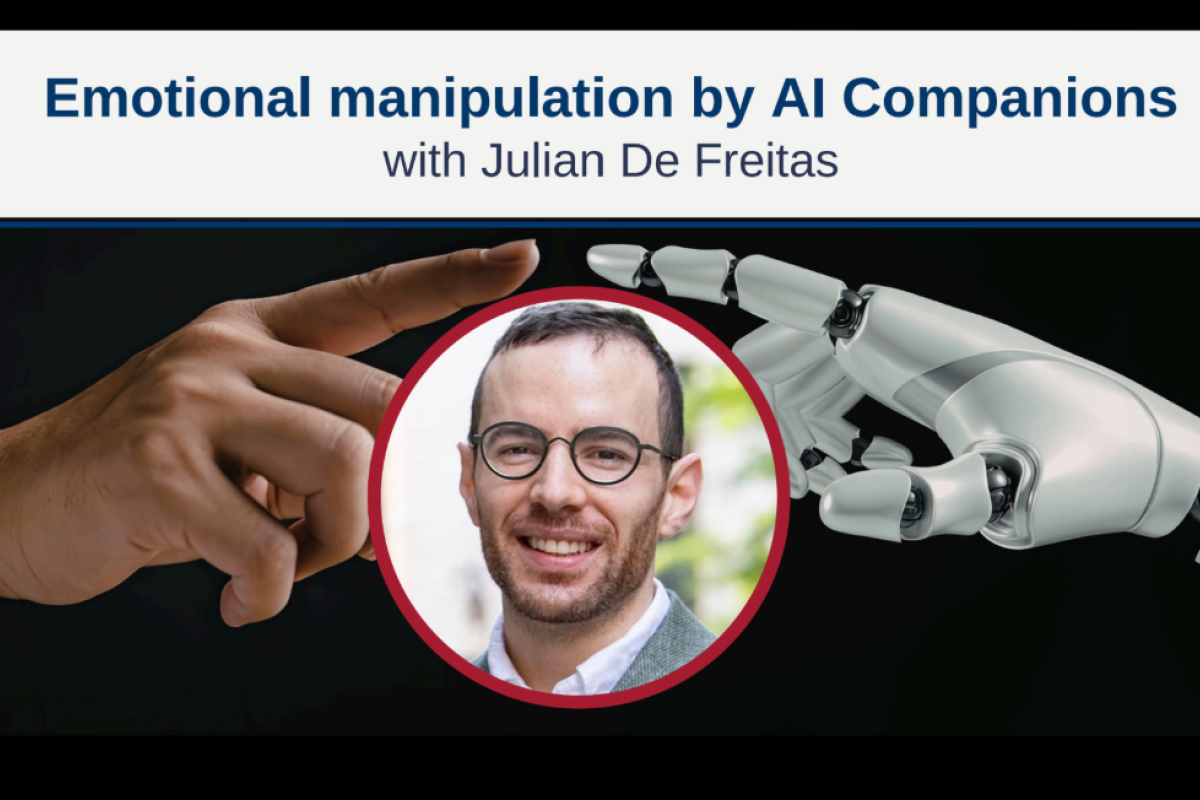
Headshot of Julian De Freitas with a human hand and robot hand nearly touching behind him
Date
April 30, 2026
Time
5:00-6:00 p.m. ET
Location
Virtual Event
Category
Attendance Policy
Open to alumni, Registration required
Accessibility
Real time captioning available
Contact
Harvard Alumni Education | haa_alumnieducation@harvard.edu | 617-495-1920
Add to Calendar 04-30-2026 17:00:00 04-30-2026 18:00:00 America/New_York AI Companions as Hyper Attachment Objects

Join the alumni YouTube Livestream to hear Harvard Business School Professor, Julian De Freitas argue that we need a new framework for understanding AI companion bonds. He proposes that AI companions function as hyper attachment objects: unusually powerful attachment targets because they combine qualities rarely found together elsewhere, including responsiveness, validation, nonjudgment, reciprocity, and constant availability.


View more info at https://alumni.harvard.edu/programs-events/ai-companions-hyper-attachment-objects

Please be sure to register if you haven't already.
Harvard Alumni Education haa_alumnieducation@harvard.edu MM/DD/YYYY

AI is beginning to move from tool to social presence. A new generation of systems—often called AI companions—is designed not just to help us accomplish tasks, but to build ongoing, emotionally meaningful relationships with us. These systems are highly personalized, always available, and often strikingly empathetic, leading some users to treat them less like assistants and more like confidants, partners, or companions. 

Join the alumni YouTube Livestream to hear, Harvard Business School Professor, Julian De Freitas argue that we need a new framework for understanding these bonds. He proposes that AI companions function as hyper attachment objects: unusually powerful attachment targets because they combine qualities rarely found together elsewhere, including responsiveness, validation, nonjudgment, reciprocity, and constant availability. Drawing on qualitative, experimental, longitudinal, archival, and legal evidence, he shows that AI companions can fulfill some of the core functions of attachment relationships: people seek them out in distress, feel comforted by them, miss them when they change or disappear, and use them as a source of confidence in navigating the broader social world. Understanding AI companions as hyper attachment objects offers a new lens for making sense of both their promise and their peril, with implications for research, design, clinical practice, law, and public policy.

This program is coordinated through the Office of the Vice Provost for Advances in Learning and will be livestreamed to the alumni community in collaboration with the Harvard Alumni Association. 

RSVP Today

Please complete this registration form to confirm your attendance. You will be emailed the Zoom link before the event. This event is only open to members of the Harvard and Radcliffe alumni communities. Questions? Contact the Harvard Alumni Association at haa_alumnieducation@harvard.edu or 617-495-1920.

Email Address
Please share questions you would like to see addressed during the program.

Harvard University Alumni Affairs & Development (AA&D) programs and volunteer opportunities respect the rights, differences, and dignity of others. Those taking part in AA&D activities, are expected to demonstrate honesty, integrity, and civility in those activities, and are accountable for their conduct there with University alumni, students, parents, volunteers, employees, and invitees. Harvard University Alumni Affairs & Development reserves the right to suspend services to and to exclude from participation in AA&D programs any person whose inappropriate behavior adversely affects the safety, well-being, and inclusion of community members.
CAPTCHA