
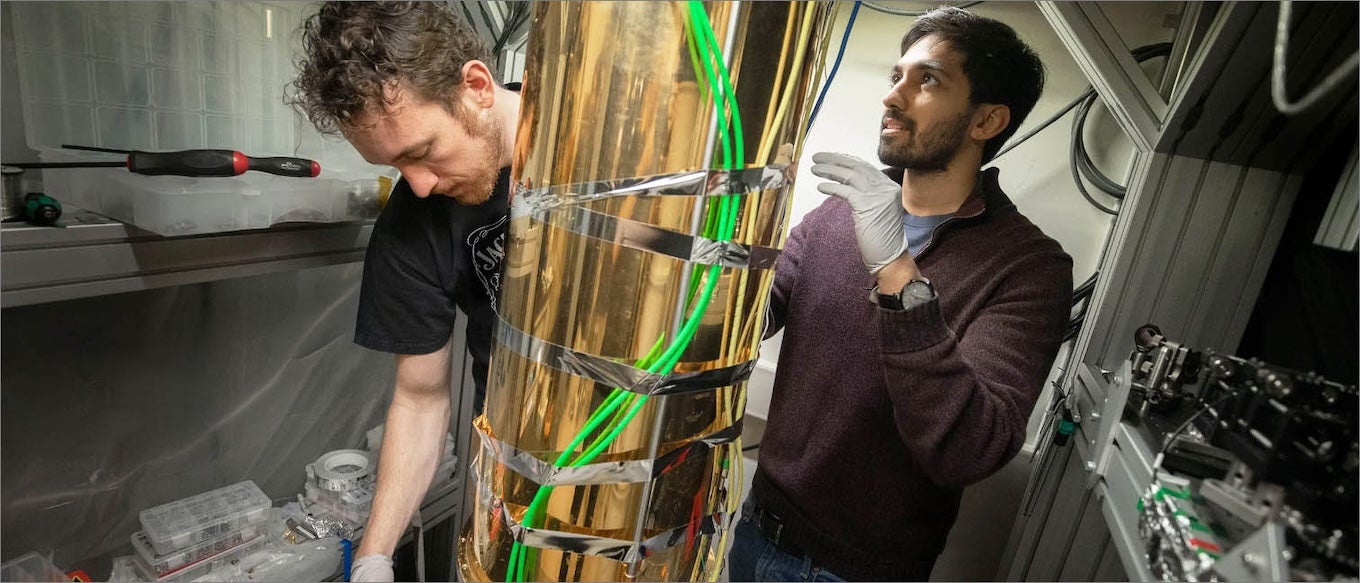
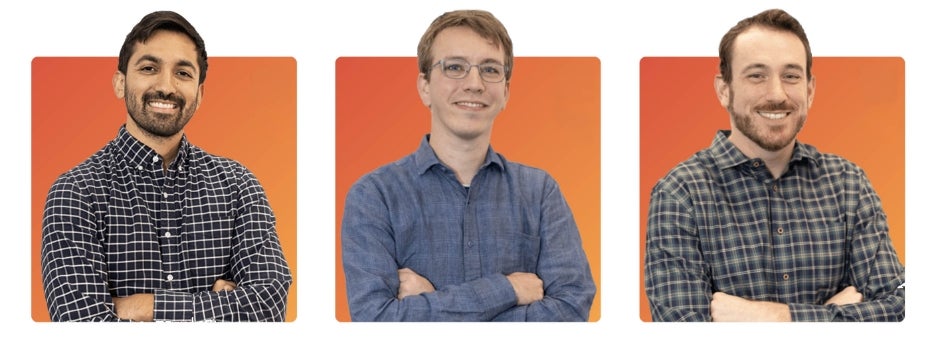
Mihir Bhaskar PhD ’21, David Levonian PhD ’21, and Bart Machielse PhD ’21 met as graduate students in the physics department. Working across two different labs, they collaborated to tackle the problem of information loss that can occur in quantum communications sent over long distances. Each brought a particular skillset to the challenge, and with the guidance of expert faculty—and later, alumni—it proved to be a fruitful convergence of minds. In November 2024, the three recent PhD graduates founded Lightsynq, a startup that created the first-ever quantum memory capable of extending the range of quantum networks.
Months later, Bhaskar, Levonian, and Machielse experienced a watershed moment: the sale of Lightsynq to IonQ, a leading quantum technology platform company.
“Lightsynq was 100 percent born out of Harvard,” says Machielse. “We would not have accomplished this without the contributions of the University community.”
Moved by gratitude, each made recent gifts to bolster quantum research at Harvard—with funding that includes support for the Harvard Quantum Initiative (HQI) and the lab of Mikhail Lukin, Joshua and Beth Friedman University Professor and co-director of HQI; the lab of Marko Lončar, Tiantsai Lin Professor of Electrical Engineering; Harvard’s Center for Nanoscale Systems (CNS); and fellowships for quantum scholars.
“Quantum science holds real potential to transform how we compute, communicate, and measure the physical world,” says Hopi Hoekstra, Edgerley Family Dean of the Faculty of Arts and Sciences. “Realizing that potential depends on sustained investment in the research ecosystem—the people, infrastructure, and the freedom to pursue difficult problems over time. These gifts strengthen and expand Harvard’s capacity for discovery in this field.”
A Diamond in the Rough
Under the direction of Professors Lukin and Lončar, Bhaskar, Levonian, and Machielse set out to solve the challenge of correcting for quantum information loss—a problem that occurs when fragile quantum signals get disturbed or fade as they are sent between devices, making quantum computing and communication hard to scale. Between the two labs, the three found themselves at the nexus of theory and engineering, working on the ground floor of developing applications of diamond quantum optics technology.
“We were at Harvard at a really exciting time, when it was starting to have significant quantum engineering capabilities,” says Machielse, “and we really benefited from the University’s pivot toward a more interdisciplinary way of thinking.”
Using a silicon vacancy center (SiV), an optically active defect in diamond, the three worked to develop quantum “interconnects” that can link many small quantum devices into a larger, modular system—helping to overcome a major scaling challenge in quantum computing and accelerating the industry’s ability to solve complex, real-world problems.
“We hope that by telling our story and by making clear how much Harvard has done for us, we can encourage other people to do the same. These types of startups would not exist without Harvard, and that gives you a responsibility to give back.”
— Bart Machielse PhD ’21
After completing their degrees, the three headed to Amazon Web Services, which launched a research alliance with Harvard in 2022, to incubate their technology. They conducted much of their work at CNS, a state-of-the-art nanofabrication facility. With the help of Harvard’s Office of Technology Development, they soon established Lightsynq.
“At every step of this process, we worked closely with Harvard,” explains Machielse, who notes the importance of having access to CNS’s cleanroom and semiconductor tools, which are used to manage SiV defects. “If Harvard hadn’t made investments in those facilities—and kept investing even when semiconductors weren’t popular—we wouldn’t have had a place to push this technology further.”
“The amount of tools and people you need is really substantial,” adds Levonian, “so it’s pretty unique to have a university that’s willing to support bringing all of that infrastructure together.“
As they moved the technology forward, they also received support from Harvard’s global network of alumni.
“We got two extremely valuable types of contributions: advice and buy-in,” explains Machielse. “Advice can be cheap, but people’s time is valuable, and alumni were excited to make that commitment. They were willing to give the advice and then ask, ‘How can I get involved?’ ”
Investing in Academic Discovery
“I believe Lightsynq has been a huge success story for Harvard’s approach to research, the communities it’s built, and the investments it’s made,” says Machielse, “and that’s why we wanted to give back.”
Having benefitted from fellowship support himself, Bhaskar felt compelled to help future graduate student researchers, establishing the Lightsynq Quantum Fellowship Support Fund.
“My own scientific career would not have been possible without numerous fellowships and sponsorships along the way,” Bhaskar says. “It’s absolutely critical for the success of quantum technology to invest in training the next generation of talent, who will be instrumental in creating new discoveries on how to scale and harness quantum technology for broad societal impact.”
With quantum technology becoming more commercially driven and tied to short-term goals, the three wanted to ensure continued support for the high-risk, foundational, and often long-term experiments that are unique to academic research institutions.
“What we’ve done with Lightsynq is commercially successful, but it was entirely speculative 10 years ago—and also resource-intensive,” says Levonian, whose gift supports SiV research in Lukin’s lab. “If everything is tied to immediate grant-related goals, it’s hard to pursue this type of innovation.”
As quantum technology shifts from academia to industry, adds Bhaskar, who is also supporting the Lukin lab, “we run the risk of neglecting the basic science and innovation that only happen in university research labs.”
Reflecting on the role Harvard played in their journey, Machielse, whose gift supports Lončar’s lab and CNS, emphasizes the importance of paying that support forward.
“We hope that by telling our story and by making clear how much Harvard has done for us, we can encourage other people to do the same,” he says. “These types of startups would not exist without Harvard, and that gives you a responsibility to give back.”